
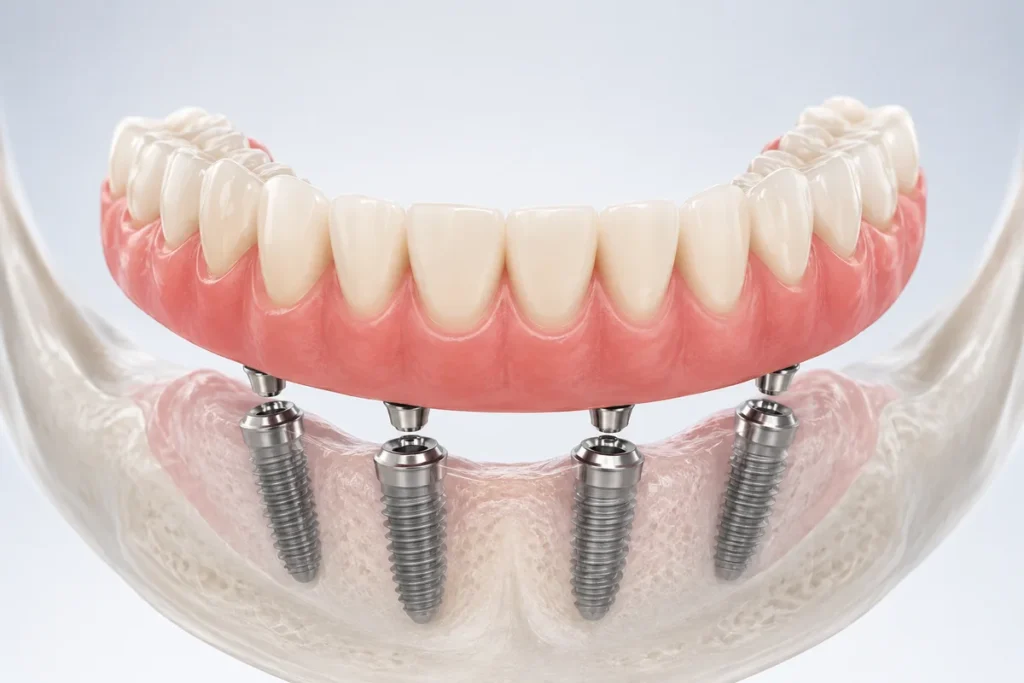
Missing teeth can affect more than your smile. It can make it difficult for you to chew comfortably, speak confidently, and enjoy many of the foods you love. While traditional dentures can replace missing teeth, some patients struggle with dentures that move or feel unstable. Implant-supported dentures use dental implants to help anchor the denture, providing a more secure option for replacing multiple or all missing teeth.
What Are Implant-Supported Dentures
Implant-supported dentures replace missing teeth and connect to dental implants anchored in the jawbone. Unlike traditional dentures, which rest primarily on the gums, these restorations use dental implants to help hold the denture securely in position. This can significantly reduce the movement and shifting that some patients experience with conventional dentures.
Removable vs. Fixed Implant Dentures
Implant-supported dentures can be designed in different ways depending on your needs, oral health, bone support, and treatment goals. Two common approaches available to you are removable implant overdentures and fixed implant-supported dentures.
Removable Implant Overdentures
A removable implant overdenture attaches to dental implants for a more secure fit while still allowing the patient to remove it for daily cleaning. Compared with a traditional denture, the implants can help reduce unwanted movement during eating and speaking.
Fixed Implant-Supported Dentures
A fixed implant-supported denture attaches securely to dental implants and remains in place throughout the day. Unlike a removable overdenture, the patient does not remove it for daily cleaning. It can provide a stable, natural-feeling replacement for an entire arch of missing teeth. The restoration still requires careful daily cleaning around and underneath it to maintain the health of the implants and surrounding tissues.
Benefits of Adding Implant Support
For appropriate patients, implant-supported dentures can offer several advantages compared with conventional removable dentures.
- Improved stability: Dental implants help secure the denture and reduce movement while eating and speaking.
- Better chewing ability: A more secure denture can make it easier to chew a wider variety of foods.
- Greater comfort: Reducing denture movement may decrease rubbing and irritation of the gums.
- Increased confidence: A more secure denture can reduce concerns about the teeth shifting during conversation, laughing, or eating.
- Improved retention: Implant support can be especially helpful for lower dentures, which can be difficult to stabilize with conventional dentures alone.
- Helps preserve jawbone: Dental implants stimulate the surrounding bone and can help reduce bone loss in the areas where implants are placed.
Who May Be a Good Candidate?
Implant-supported dentures may be an option if you are missing most or all of the teeth in your upper or lower arch, and you want greater stability than a traditional denture can provide. Candidates need adequate oral health and sufficient bone to support dental implants. However, bone grafting may sometimes be considered when additional bone is needed.
Overall health, medications, smoking or tobacco use, gum health, bone quality, and the condition of any remaining teeth can also affect your treatment planning. Your dentist will perform a comprehensive examination and use appropriate imaging to determine whether dental implants and an implant-supported denture are suitable for you.
What is the Implant Denture Process?
Your dental team plans treatment specifically for you. The exact sequence can vary depending on whether you need tooth removal, bone grafting, or a removable or fixed implant-supported denture.
- Consultation and evaluation: Your dentist evaluates your teeth, gums, bite, medical history, and treatment goals. Dental imaging is used to evaluate the jawbone and plan implant placement.
- Implant placement: Your dentist surgically places implants into carefully planned positions in the jawbone.
- Healing and integration: The implants then need time to heal and integrate with the surrounding bone. The length of this healing period varies by patient and treatment plan.
- Creating the denture: Your dental team takes records to design the implant-supported denture for proper fit, function, appearance, and connection to the implants.
- Delivery and follow-up: Your dentist attaches the completed denture to the implants. Follow-up visits allow your dental team to evaluate comfort, function, hygiene, and the health of the implants and surrounding tissues.
How Do You Care for Implant-Supported Dentures?
Implant-supported dentures require regular home care from you, as well as professional maintenance from your dental provider. Although dental implants cannot develop cavities, plaque and bacteria can accumulate around the implants and surrounding gum tissues. Keeping these areas clean is important for maintaining the health of the implants and supporting tissues.
Patients should remove and clean removable implant overdentures as directed by their dentist. The implants and attachment components also need daily cleaning. Fixed implant-supported dentures remain in the mouth and require cleaning underneath and around the restoration. Appropriate brushes, flossing aids, or other cleaning devices are recommended by your dental team.
Regular dental examinations are also important so the implants, denture, bite, attachment components, and surrounding tissues can be evaluated over time.
Implant-Supported Dentures vs. Traditional Dentures
Traditional dentures rest on the gums and rely on the shape of the jaw, surrounding tissues, and—in the upper arch—suction for retention. As the jawbone changes over time, a denture may become less stable and may require adjustment, relining, or replacement.
Implant-supported dentures use dental implants to provide additional support and retention. This can reduce movement and improve stability during chewing and speaking. Depending on the design, an implant-supported denture may be removable by the patient or fixed to the implants.
Neither option is right for everyone. The best approach depends on factors such as oral health, available bone, overall health, treatment goals, maintenance requirements, and cost.
Cost and Insurance Consideration?
The cost of dentures varies depending on the individual treatment plan. Factors can include the number of dental implants needed, whether teeth need to be removed, the need for bone grafting or other procedures, and whether the final restoration is removable or fixed.
Dental insurance coverage also varies by plan. Some plans may provide benefits toward certain portions of treatment, while other services may have limited or no coverage. Before treatment begins, our team can help you understand the estimated costs associated with your recommended treatment plan and available insurance benefits.
Frequently Asked Questions
Are implant-supported dentures removable?
They can be. Patients can remove some implant-supported dentures for cleaning. Other designs remain fixed to the dental implants, and only a dental professional removes them when necessary. The appropriate design depends on the patient’s individual needs and treatment plan.
How many implants are needed for implant-supported dentures?
The number of implants you need varies depending on the jaw being treated, the amount and quality of available bone, the type of denture, and other individual factors. Your dentist will determine the appropriate number and location of implants during your treatment planning.
Can I get implant-supported dentures if I already wear dentures?
Many patients who currently wear traditional dentures may be candidates for implant-supported dentures. Your dentist will examine your mouth and use dental imaging to evaluate your jawbone, oral health, existing denture, and available treatment options.
Do implant-supported dentures feel more secure than traditional dentures?
Implant support is designed to improve retention and stability of your denture. Many patients experience less movement during chewing and speaking compared with conventional dentures, although results vary according to the individual and the type of restoration.
Are Implant Dentures Right for You?
If loose or unstable dentures are making it difficult for you to eat, speak, or smile comfortably, implant-supported dentures may provide another option. At Monticello Dental Care, we can evaluate your oral health, discuss your goals, and help determine which tooth replacement options may be appropriate for you.
At Monticello Dental Care, Dr. Dejti has pursued advanced continuing education in implant dentistry through the Misch Implant Institute. This additional training supports a comprehensive approach to evaluating dental implant and tooth replacement options for our patients.